
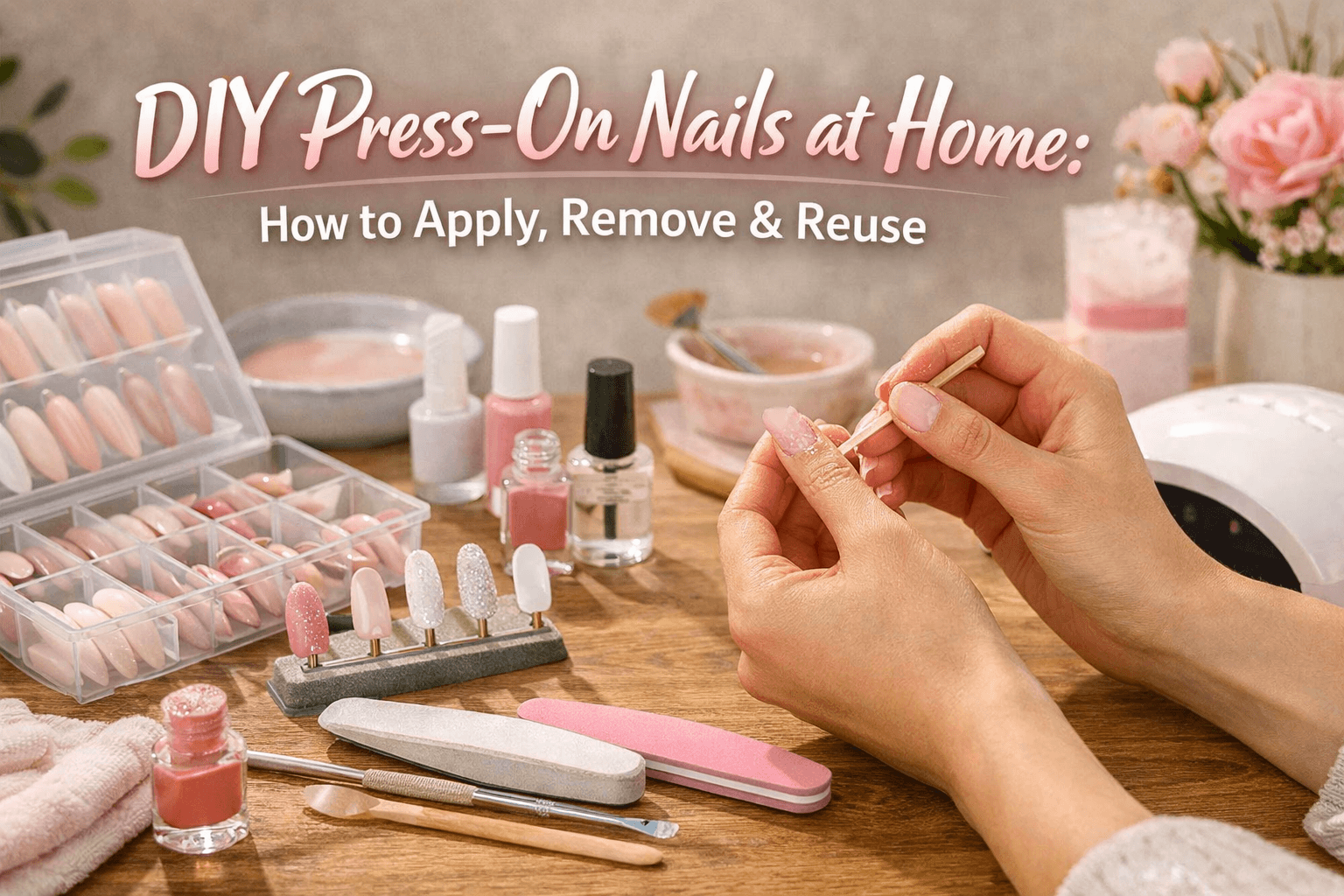
If you love the look of a fresh manicure but not the time, cost, or nail damage that can come with frequent salon visits, DIY press-on nails are your secret weapon if you want an easy way to apply press-on nails at home. They’re fast, affordable, and done right surprisingly durable. Many people switch to press‑ons after dealing with weak nails, chipped polish, or a schedule that doesn’t allow for two‑hour appointments. This guide distills everything you need to know to create, apply, remove, reuse, and care for press‑on nails at home.
By the end, you’ll know which tips to choose, how to prep for lasting wear, the best application techniques, and what to do when something goes wrong. You’ll also get pro pointers that make your sets look salon‑level and last longer. If you’ve been on the fence, don’t miss the ease and confidence a well‑made press‑on set can bring to your routine.
How to apply press-on nails at home:
- Prep nails by cleaning and lightly buffing
- Choose the correct nail size
- Apply glue or adhesive evenly
- Press from cuticle to tip and hold 20–30 seconds
- Avoid water for at least 2 hours
What are press‑on nails, really?
Press‑ons are pre‑shaped, full‑coverage tips often made from ABS plastic or soft‑gel materials that cover the entire nail plate. They’re secured using adhesive tabs, brush‑on nail glue, or gel adhesive cured under a nail lamp. Unlike traditional extensions built on your hand, press‑ons are decorated off‑nail, then applied in minutes. That means cleaner cuticles, better symmetry, and the option to reuse sets multiple times.
Adhesive choice drives longevity and removal:
- Adhesive tabs are the least invasive and best for a weekend or special event.
- Brush‑on glue typically offers about a week of wear with proper prep.
- Gel adhesive, cured under LED/UV, can deliver the longest wear when applied correctly.
Many readers find a “tabs for short wear, glue or gel for long wear” strategy offers the best of both worlds.
How to choose the right press-on nails for your nail shape
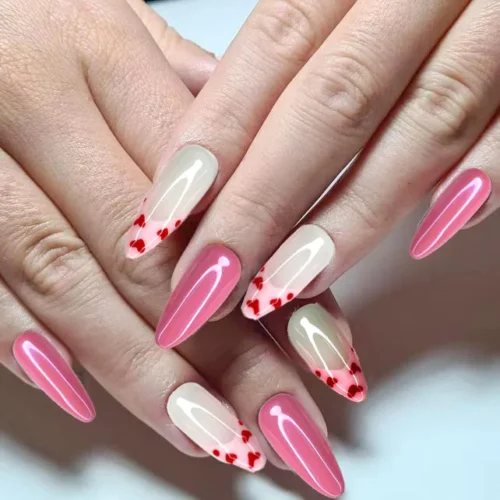
A natural‑looking press‑on starts with fit. Each tip should meet your sidewalls (the edges of your natural nail) without pressing or flaring. If a tip feels tight, size up and lightly file the sidewalls of the tip, never force a too‑small tip. Shapes like short oval or almond are the most forgiving and comfortable for everyday tasks; longer coffin and stiletto styles show off design beautifully but require more care.
Consider:
- Length: Start with short to medium if you work with your hands. Longer styles can be reserved for occasions.
- Shape: Oval/almond read most natural; square/coffin are modern and photo‑friendly.
- Apex and curve: Soft‑gel tips with a gentle apex often fit flatter nail plates better, reducing lift.
New to DIY? Consider trying a short‑to‑medium oval kit first. It’s the easiest path to a polished, believable result.
Essential tools for DIY press-on nails at home
You can create beautiful, durable DIY press‑ons with a compact kit. Stock:
- Full‑coverage tips in your preferred shape and length
- Nail stands and reusable putty or double‑sided solid tape
- Fine file (180–240 grit), buffer, and cuticle pusher
- Lint‑free wipes, alcohol or nail cleanser, and a dehydrator/primer (optional but helpful)
- Base coat, color, and top coat (gel polishes are the most durable on tips)
- LED/UV nail lamp if using gel products
- Adhesive tabs, brush‑on glue, or gel adhesive
- Cuticle oil and a small travel‑size hand cream
You might build a small caddy with these essentials to make set‑making and quick repairs effortless.
How to prep your nails for press-on nails that last
Longevity and nail health start before any polish touches the tip.
- Wash and dry hands thoroughly. Avoid lotions for several hours pre‑application.
- Gently push back the eponychium (often called “cuticle”). Remove only non‑living tissue from the nail plate using a gentle tool. Never cut or force live skin.
- Shape free edges so each nail matches the press‑on’s outline.
- Lightly buff the nail surface to remove shine. You’re creating microscopic texture for adhesion, not thinning the nail.
- Cleanse with alcohol or a nail cleanser. If you have oily nails or struggle with lifting, a dehydrator and non‑acid primer can help.
Apply nails in the evening and keep hands dry afterward. Many readers notice markedly better retention with a “prep, apply, then sleep” routine.
Prep the tips for paint and perfect fit
Prepping tips makes your art smoother and your application cleaner.
- Place each tip on a stand with a solid chunk of reusable putty so it doesn’t wobble.
- Lightly file away the tiny attachment nub at the free edge and smooth the edges so top coat won’t pool.
- To improve adhesion later, gently etch the underside of the tip where it will meet your nail. A quick “kiss” with a fine buffer is enough.
- Wipe tips with alcohol to remove dust and oils.
Consider creating two extra tips for each hand in nearby sizes. Many makers include spares to cover in‑between nail widths or the occasional mid‑week replacement.
How to design DIY press-on nails like a pro
Press‑ons shine because you decorate them off the hand, with your dominant hand, and without flooding cuticles. If you’re using gel polish:
- Start with a thin base coat and cure per your product’s instructions.
- Apply two thin, even color coats, curing between layers. Thinner layers look more natural and chip less.
- Add art (French lines, chrome, decals, or minimal accents) and fully cure.
- Top coat for protection. Gloss creates a glassy, salon look; matte reads editorial and modern. Cap the free edge to reduce tip wear and cure thoroughly.
If you plan to reuse sets, keep designs slightly away from the sidewalls and free edge. It prevents lifting and makes later filing and refresh easy.
Save a few accent nails to mix with simpler sets. Many readers build a “capsule wardrobe” of press‑ons they can swap for new looks in minutes.
Size and organize like you mean it
Before application, line up tips from thumb to pinky for each hand and verify the fit again. Label the underside of each tip with a fine marker (e.g., “L2, R3”), or note sizes in a small card. Keep finished sets in small bags or a divided case. Including two extra sizes for thumbs or pinkies saves time later and helps you avoid emergency reshaping.
If you plan to make multiple sets, consider standard “Small/Medium/Large” size bundles with a few spares. It’s a smart system for personal use and makes gifting easy.
Application: the salon‑quality method
Great wear comes from even pressure, zero gaps, and adhesive control.
- Choose your adhesive. Tabs are gentle and removable; brush‑on glue offers durable daily wear; gel adhesive (cured) can last the longest when used with a lamp.
- Apply to clean, prepped nails. For glue, a thin layer on your natural nail and a thin layer inside the tip helps prevent air pockets. For tabs, choose the size that covers the nail fully without overlapping skin. For gel adhesive, follow your product’s base prep and cure timings precisely.
- Apply from the cuticle line at a slight angle. Slide the tip down to meet the cuticle without overlapping skin, then roll it forward to seal the free edge. Watch for air bubbles; if you see one, lift immediately and reapply before the adhesive grabs.
- Hold firm, even pressure for 20–30 seconds per nail. Wipe away any squeeze‑out before it cures or sets.
- Once all nails are on, gently refine side edges with a fine file to blend, then cleanse away dust. Finish with cuticle oil on skin only and avoid the seam for a couple of hours.
Set yourself up for success: consider applying just before bed so your hands stay dry and inactive during the first crucial hours.
How to make press-on nails last longer
Daily habits make the biggest difference.
- Keep nails dry for at least two hours post‑application. Longer is better.
- Treat nails like jewels, not tools. Use a key or opener, not your nail, to lift tabs or packages.
- Wear gloves for dishes and cleaning. Repeated hot water exposure softens adhesives.
- Re‑oil cuticles daily. Hydrated skin looks fresher and reduces the temptation to pick.
- Carry a mini repair kit with an alcohol wipe, a tiny file, and spare tabs or glue for quick fixes.
If you notice early lifting near the sidewalls, lightly remove oil with an alcohol wipe and seal the edge with a tiny dot of glue. Many readers choose a neutral, short set for everyday wear and reserve longer or embellished sets for events to maximize longevity.
How to removal and reuse press-on nails without damage
Never pry. Choose the gentlest method for your adhesive type.
- Adhesive tabs: Soak nails in warm, soapy water for several minutes, then slide dental floss or a thin cuticle stick under the side and “saw” gently toward the center. Clean remaining adhesive from the nail and tip with oil.
- Brush‑on glue: Massage cuticle oil around the seams, then soak in warm, soapy water with a little oil. Work slowly from one side with a wooden pusher. Reapply oil and patience; rushing can lift layers of your natural nail.
- Gel adhesive: Follow the product’s instructions. Most require oil and warm, soapy water; some benefit from a brief wrap with oil‑soaked cotton. Avoid acetone unless your product specifically requires it, as acetone can cloud or weaken reusables.
To reuse, gently buff away residual glue from the underside of the tip, cleanse, and store in a labeled case. With careful handling, many sets can be worn multiple times, stretching your cost per wear to just a few dollars.
You might keep a small, labeled storage box for finished sets, organized by shape, length, and color, so choosing your look is as simple as picking jewelry.
Common press-on nails problems and fixes
- Nails pop off within a day: Revisit prep. Any residual oil, lotion, or dust prevents adhesion. Lightly etch the underside of the tip and the nail plate, dehydrate, and try again. Ensure your tip isn’t too small; a squeezed tip will spring off.
- Lifting at sidewalls: The tip may be too flat for your natural curve. Size up and tailor the sidewalls, or choose a tip line with a softer apex. Seal edges with a whisper‑thin bead of glue during application.
- Air bubbles: Use thinner adhesive layers and apply from the cuticle at an angle, rolling forward to push out air. If you see a bubble, lift immediately and reset.
- Crooked application: Dry‑fit each tip and mark the center of your nail bed with a washable dot. Align the tip’s center before pressing.
- Flooded cuticles or glue burns: Use less product and keep it away from skin. Brush‑on glues give more control than squeeze tubes.
- Tip cracking: Overfiling the free edge or pressing too hard can weaken tips. Cap your top coat along the edge and avoid using nails as tools.
Safety and nail health
Patch‑test new adhesives on one nail before a full set if you have sensitive skin or a history of allergies. Work in a ventilated space, avoid skin contact with glues, and keep products away from children and pets. Give nails periodic breaks: a few days bare with oil and a strengthening treatment keeps your natural nails resilient. If you notice persistent redness, pain, or separation from the nail bed, stop use and consult a professional.
Cost and time: what to expect
Once you assemble a basic kit, each set costs only a fraction of a salon appointment especially if you reuse tips. Designing a set might take 45–90 minutes (faster with practice), and applying a finished set can be as quick as 10–15 minutes. The payoff is flexibility: you can switch looks the night before an event or whip up a replacement nail in minutes.
Conclusion: DIY press-on nails step by step
Choose tips that match your nail width without forcing, gather a simple kit (tips, stands, cleanser, base/color/top if using gel, adhesive, lamp for gel). Prep matters most: push back non‑living cuticle, lightly buff, cleanse, and keep hands dry. Etch and clean the tips, paint in thin layers, and fully cure. When applying, use a thin, even layer of adhesive, set the tip from cuticle to free edge at an angle, and hold firm pressure for 20–30 seconds. Keep nails dry for a couple of hours, wear gloves for wet work, and oil cuticles daily. Remove gently never pry and clean the underside to reuse. With consistent prep and a few pro habits, DIY press‑on nails look salon‑quality, last longer, and protect your natural nails.
Comment (1)