If your press-on nails are too curved, they may look gorgeous in the box but feel pinchy, pop off at the sides, or leave a gap you can see straight through because of curve mismatch. Most mass-produced C-curve press-on nails are built with a noticeable arch. That curve looks sleek on many hands, but if your natural nails are flatter, the press-ons can clamp down at the center, lift at the sides, or refuse to sit flush near the cuticle.
The result is usually discomfort, early lifting, or tiny moisture traps you do not want under your manicure.
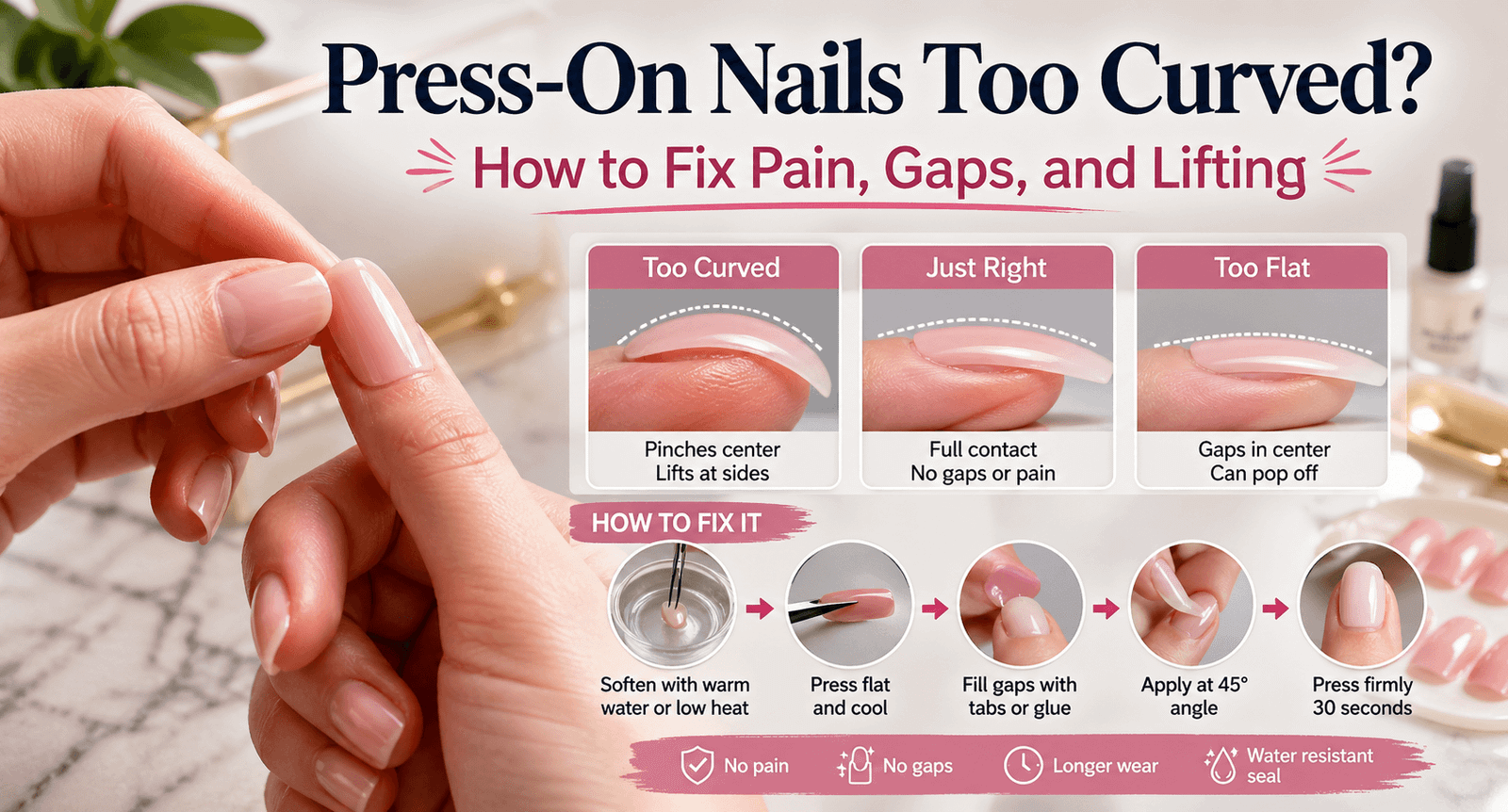
Quick answer: If your press-on nails are too curved, they may pinch the center of your nail, lift at the sides, or leave air gaps. The fix is to size correctly, gently flatten the press-on with warm water or low heat, fill small gaps with adhesive, and press for 30 seconds during application.
Why Press-On Nails Too Curved Hurt or Pop Off
Curve mismatch creates pressure and air pockets. When a highly curved tip meets a flatter nail bed, the press‑on touches down at the center first and hovers near the sidewalls. If you force it flat with lots of pressure or glue, it squeezes the nail plate. That can feel tight or achy and may leave a white stress line across the center. If you don’t press enough, you’ll see side lift that catches hair and funnels in water.
Other culprits sometimes add to the problem:
- Press‑ons sized too small pinch the nail; too large push into side skin and cuticle.
- Over‑buffing thins the natural nail so pressure is more noticeable.
- Excess glue floods the skin, causing irritation, or prevents the nail from seating evenly.
- Trapped moisture under lifted edges can lead to discoloration or infection if ignored.
Fixing the curve is the fastest route to comfort and you can do it before you ever open the glue.
Quick Fit Check for Flat Nail Beds and Curved Press-Ons
Lay each tip on your bare nail without adhesive and look from three angles: straight on, side view, and from the free edge. You’re aiming for relaxed contact along the sidewalls and a cuticle line that mirrors your own.
- If the tip sits nicely at the sides but hovers in the middle, the nail is too flat; you’ll need a little more glue or a thicker adhesive to fill the center.
- If the tip hugs the center and floats at the sides, it’s over‑curved for you; lightly softening and flattening the press‑on often solves it.
- If you have to press hard to make it reach the sidewalls, the size is too small; size up and shape the sidewalls instead of forcing a tight fit.
- If the tip overlaps your skin or cuticle, size down or refine the cuticle edge to match your contour.
Before committing, take a minute to test two adjacent sizes on each finger. Many readers find that sizing up one number and custom‑shaping the sidewalls makes the whole set look salon‑done.
How to Prep Natural Nails Before Applying Press-Ons
Great wear starts with clean, dry, lightly‑textured nails. Wash hands, remove oils with an alcohol wipe, and push back cuticles gently. Buff only until your nail surface looks matte as ten light strokes are usually plenty. Over‑buffing thins the nail and increases sensitivity.
Avoid lotions and water exposure for at least 30 minutes before application. Clean, dry plates let adhesives do their job without sliding.
How to Flatten Press-On Nails Safely
You can reduce a strong C‑curve just enough to fit your nail without warping the design. Work slowly, test often, and protect embellishments.
The warm‑water softening method
This is the gentlest way to relax the curve.
- Heat a mug of water until it’s steaming but not boiling.
- Using tweezers or a small strainer, dip one press‑on for 1–2 seconds, remove, and immediately press the nail onto a clean, flat surface. Use your fingertips to apply even pressure for 10–15 seconds.
- Let it cool fully, then test the fit. Repeat in tiny increments if needed.
Why it works: Most press‑ons are made from plastic or soft‑gel materials that become slightly more flexible when warm, then hold their new shape as they cool.
Safety notes: Don’t submerge nails with chunky gems or 3D pieces since heat can loosen embellishments. Keep water below a rolling boil, and never bend while the nail is overly soft.
The low‑heat blow‑dryer method
For sets with intricate art, warm air lets you control softening without moisture.
Hold the press‑on with tweezers and pass the underside through warm airflow for a few seconds. Press onto a smooth board, hold, cool, and test. Short, repeated passes are safer than one long blast. Keep heat low to protect topcoat shine.
Strategic sidewall refining
If you sized up to avoid pinching, refine the width so the nail hugs your sidewalls without overhang. Use a fine file and work only on the side edges and free edge not across the top surface where the gel layers live. Light, even strokes keep the seal intact and prevent peeling later.
If your set is heavily designed, consider practicing these adjustments on the thumbs first since there’s more surface area and the results are easiest to see. Once you like the fit, repeat for the rest.
Best Adhesives for Flat Nails and High C-Curve Press-Ons
Curve mismatch often leaves press-on nails gaps between your nail plate and the underside of the tip. Filling that space evenly makes the manicure look flush and last longer.
For flat natural nails wearing curved tips, these approaches work well:
- Adhesive tab + glue combo: Place a thin adhesive tab 1–2 mm away from the cuticle to act as a soft “cushion.” Add a light layer of nail glue on top of the tab and a small dot on the center underside of the press‑on. Apply at a 45‑degree angle from cuticle, then roll forward and press. The tab fills the center; the glue seals the edges.
- Thicker, gap‑filling glue: Gel‑like nail glues are designed to bridge small spaces. Use a rice‑grain amount in the center of the natural nail and a thin swipe along the press‑on’s sidewalls. Too much product will ooze; just enough creates a vacuum seal without flooding the skin.
- Double‑tab method for very flat nails: If you still see daylight through the center, stack two slim tabs and use a whisper of glue at the sidewalls. Expect strong hold so removal will require a proper soak.
Application rhythm matters more than force: seat the cuticle edge first, roll forward, then press with firm, even pressure for 30 seconds per nail. Actually count. Many failed applications come down to rushing this step.
How to Make Press-On Nails Look Natural and Comfortable
Two tiny tweaks take a set from “press‑on” to “professional.”
- Cuticle contouring: Gently bevel the underside of the press‑on’s cuticle edge so it tucks neatly where your eponychium begins. Don’t thin the visible topcoat, just soften the back edge to mirror your natural curve.
- Length and shape choices: The flatter your natural nails, the more dramatic curves will feel at longer lengths. If you love sculpted looks, consider slightly shorter lengths with a soft square or almond to reduce leverage and pressure. Many readers find that one length down doubles comfort and wear time.
Troubleshooting Press-On Nails: Pain, Side Lift, and Gaps
If a nail feels tight 10–15 minutes after application, it’s not going to “loosen up” on its own. Remove that one nail, adjust the curve or size, and reapply. Wearing through pain risks nail plate soreness and makes lifting more likely.
Side lift that catches hair usually means the curve still overpowers your sidewalls or you under‑filled the center. Remove, soften the curve slightly, or add a tiny bit more adhesive at the side edges and reseat the nail. Avoid immersing your hands for prolonged periods within the first hour as adhesives finish setting.
Water is the frenemy of press‑ons. Keep hands out of hot tubs, steamy dishwater, and long baths for the first few hours. After that, dry thoroughly after washing. A quick daily run of cuticle oil at the sidewalls helps create a water‑repellent seal and keeps the manicure looking fresh.
When to Remove Press-On Nails and Reapply
Take the set off if you notice persistent throbbing, heat, redness around the skin, or a greenish stain under the nail. Pain often signals pressure from a too‑tight fit; redness and itch can mean a glue reaction; green staining points to trapped moisture and bacteria. Don’t pry. Instead, soak in warm, soapy water with a bit of oil until the adhesive loosens, or follow your product’s removal instructions. Cleanse the nail plate, rest for a day or two if needed, then re‑fit with the adjustments above.
How to Measure Nails for Better Press-On Fit Next Time
A few minutes of measuring translates into a week or more of chip‑free wear.
For a quick at‑home method, use a strip of clear tape across each nail from sidewall to sidewall. Mark the widest points with a pen, stick the tape onto paper, and measure the distance in millimeters. If you’re between sizes, round up; you can always refine the sidewalls. Snap a straight‑on photo of each hand and one from the side because being able to see your nail’s natural curve helps you pick “natural/flat” or “structured/high apex” tips that match your anatomy.
If you’re ordering customs, consider requesting a sizing kit. Trying on physical sample tips removes guesswork, and you can message the maker with photos so they tailor the cuticle contour and apex for you.
Step-by-Step Fix for Press-On Nails Too Curved
- Dry fit every tip before using glue.
- Choose sizes that touch the sidewalls without pressure.
- If between sizes, choose the larger size and file the sides.
- Lightly prep the natural nails and remove oils.
- Soften overly curved tips with warm water or low heat.
- Fill small gaps with an adhesive tab, thicker glue, or both.
- Apply from the cuticle at a 45-degree angle.
- Press evenly for 30 seconds per nail.
- Avoid water for the first few hours.
- Remove and reset any nail that pinches.
Conclusion: Fix the Curve Before You Glue
Press‑ons that are too curved for your natural nails cause pressure in the center and lifting at the sides; forcing them flat only invites pain and early pop‑offs. The fix is simple: choose sizes that reach the sidewalls without squeezing, prep lightly, and adjust the curve with gentle warmth before you glue; when you’re ready for a better match, you can shop press-on nails by length, shape, and style. For flat nail beds, fill the center gap using an adhesive tab and a small amount of glue or a thicker, gap‑filling adhesive then apply at a 45‑degree angle and press for a full 30 seconds. Avoid water for a few hours, remove and reset anything that pinches, and measure your nails so the next set matches your natural curve from the start.
FAQ: Curved Press-On Nails, Flat Nail Beds, and Glue
Is boiling water safe for reshaping?
No. You need gentle softening, not a melt. Steaming‑hot not boiling water offers control and protects both the design and your fingers.
Will flattening ruin the artwork?
Done lightly, no. Work in short intervals, keep heat low, and avoid bending while the nail is super soft. Skip heat if the nail has large stones or 3D elements.
Why do some nails hurt only when I bump them?
That’s often a sign of over‑buffing or a thin natural plate and pressure feels sharper. Scale back prep next time and prioritize curve adjustments over forceful pressing.
Why do some nails hurt only when I bump them?
That’s often a sign of over‑buffing or a thin natural plate and pressure feels sharper. Scale back prep next time and prioritize curve adjustments over forceful pressing.
How much glue is “just right”?
Think thin and targeted. A small bead in the center and a whisper along the sidewalls is enough. If glue squeezes onto your skin, you used too much.
How long should I hold each nail?
Count a full 30 seconds. Consistent pressure sets the bond and prevents micro‑gaps you can’t see but water can find.